



It starts small. You grab lunch with a client and pay with your personal card. You buy a notebook for work at the same time you pick up groceries. You use your home internet for business calls and personal browsing.
Before long, your business and personal expenses are completely mixed together — and untangling them at tax time becomes a stressful, time-consuming mess.
Splitting business and personal expenses is one of the most important financial habits a small business owner or freelancer can build. This guide explains why it matters and exactly how to do it.

Mixing the two does not just make bookkeeping harder. It creates real financial and legal risks:

The single most effective thing you can do is open a separate bank account exclusively for your business. All business income goes in. All business expenses come out. Your personal account stays completely separate.
Most banks offer free or low-cost business checking accounts. You do not need a large balance to get started — just the discipline to keep it separate from day one.
Tip: If you are a sole proprietor or freelancer, a separate account still matters even without a formal business structure. The separation is about your financial records, not just your legal entity.

A dedicated business card means every business purchase is automatically separated from your personal spending. You never have to sort through a combined statement trying to remember which coffee was a client meeting and which was just a Tuesday morning.
Business credit cards also often come with expense tracking features, cashback rewards on business categories, and higher credit limits that help manage cash flow for larger purchases.
The rule is simple: if it is a business purchase, it goes on the business card. If it is personal, it stays on the personal card. No exceptions.

One of the biggest reasons business and personal expenses get mixed is that owners dip into business funds for personal needs. The fix is to pay yourself a regular, set amount — either a salary or an owner’s draw depending on your business structure.
Transfer that amount from your business account to your personal account on a fixed schedule. Once it is in your personal account, spend it however you like. But from the business account, only business expenses should flow out.
This habit alone eliminates most of the mixing problem for small business owners.

Some expenses are genuinely shared between business and personal use. Your home internet, your mobile phone plan, and your home office space are common examples. These require a different approach — not avoidance.
The IRS allows you to deduct the business-use portion of mixed expenses. Here is how to handle the most common ones:
Important: The IRS requires that home office deductions apply only to space used regularly and exclusively for business. A guest room that doubles as a desk does not qualify.

Separating your accounts is the foundation, but documenting your business expenses is what makes that separation useful at tax time. Every business purchase needs a receipt — stored, categorized, and easy to retrieve.
For each business expense, you should record:
Paper receipts fade, get lost, or pile up in a drawer. Using a receipt management app like Manage Receipt lets you scan each receipt the moment you get it, tag it to the right category, and build a clean digital record automatically.

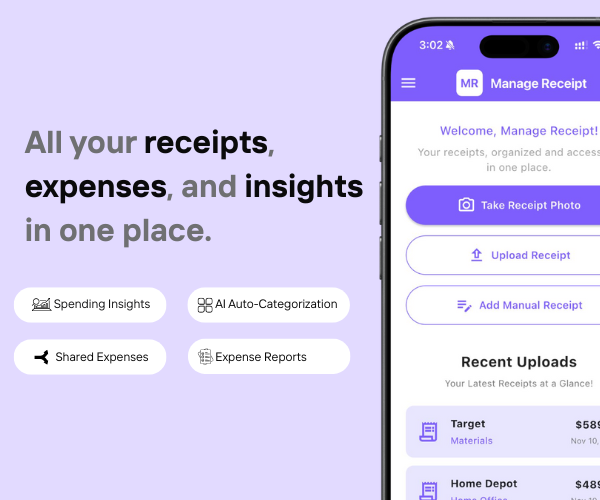
Whether you use a credit card or debit card, the real challenge is organizing proof.
Manage Receipt helps bridge that gap by ensuring every transaction has proper documentation.
With Manage Receipt, you can:
Capture receipts instantly to prevent loss
Store all receipts in one centralized system
Access proof quickly for approvals and audits
Improve visibility into spending
Reduce manual work and admin overhead
The biggest benefit of using ManageReceipt isn’t just the time you save. It’s the money you keep — because every receipt you capture is a deduction you can actually claim.
Try ManageReceipt free today — available on iOS and Android. No credit card required.
Click Here to know more about how Manage Receipt helps small businesses.

The IRS defines a deductible business expense as one that is both ordinary (common in your industry) and necessary (appropriate for your business). Common examples include:
Personal expenses are never deductible even if paid from a business account by mistake. If that happens, record it as an owner’s draw and correct it right away.

Every tool on this list helps you run your business better. But none of them matter if your financial records are a mess.
Before you invest in project management software, marketing tools, or e-commerce platforms — make sure your expense tracking is airtight. Every purchase you make for your business needs to be documented, categorised, and stored correctly. Not just for tax season, but for understanding whether your business is actually profitable.
That is exactly what ManageReceipt is built for. Scan a receipt in seconds, add the business purpose, and it is stored, backed up, and export-ready. No shoebox of crumpled paper. No scrambling at tax time.
Download ManageReceipt Free — Start Tracking Expenses Today
iOS & Android | managereceipt.com


© 2025 Manage Receipt. All Rights Reserved.
