Meals and Entertainment Deductions: 2026 Rules Explained

Meals and Entertainment Deductions: 2026 Rules Explained

5 Tips for Filing Small Business Taxes for the First Time | Beginner Guide

Few areas of the tax code generate as much confusion for small business owners as meals and entertainment. The rules have shifted multiple times over the past several years, and 2026 brings another round of changes — particularly around employer-provided meals. Here’s a clear breakdown of what’s deductible, what isn’t, and what changed this year.

5 Tips for Filing Small Business Taxes for the First Time | Beginner Guide

The Big Picture: Entertainment vs. Meals

Small Business Expense Management Tips | Smarter Business Finances

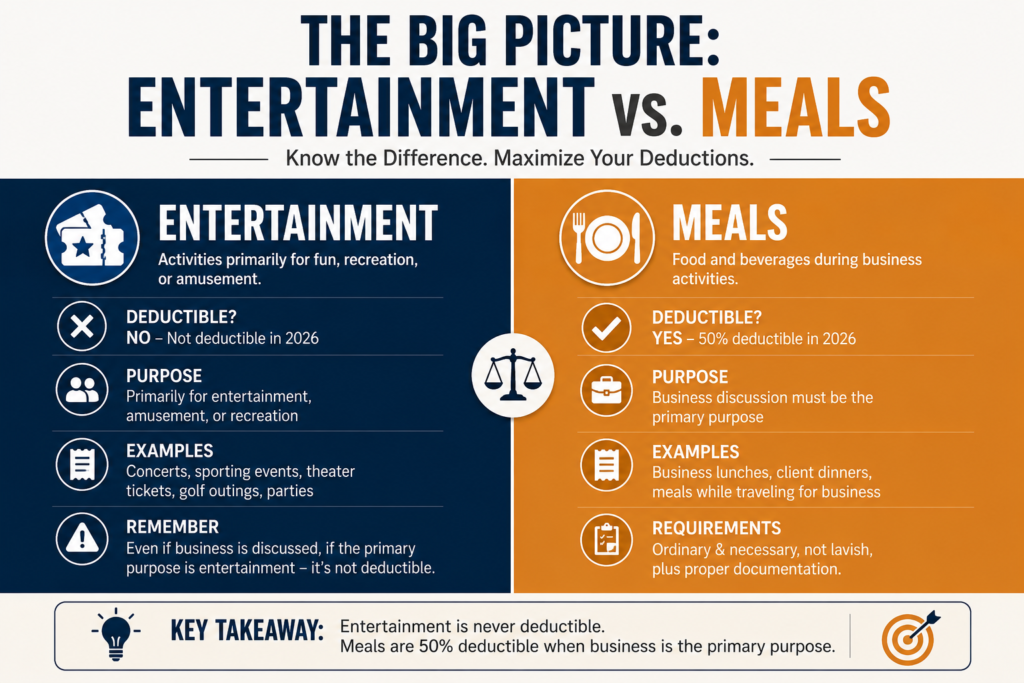
The Big Picture: Entertainment vs. Meals

It helps to separate these two categories right away, because they’re treated very differently.

Entertainment expenses — things like sporting events, golf outings, concerts, or similar recreational activities — are generally 100% nondeductible. This has been the rule since the Tax Cuts and Jobs Act took effect in 2018, and it remains unchanged for 2026. Taking a client to a baseball game, even if it strengthens the business relationship, doesn’t qualify for a deduction on its own.

Meals, on the other hand, can often still be partially deducted, as long as certain conditions are met.

The 50% Rule for Business Meals

How Receipts Impact Tax Deductions | Why Proof Matters

For most ordinary business meals, the long-standing 50% deduction still applies in 2026. To qualify, the meal generally needs to meet a few conditions:

  • The expense must be ordinary and necessary for your business
  • The meal can’t be lavish or extravagant under the circumstances
  • The business owner or an employee must be present at the meal
  • There must be a clear business purpose, and the expense needs to be properly documented

This covers common scenarios like taking a client out for lunch, grabbing dinner with a business partner to discuss a deal, or eating meals while traveling away from home on business. In all of these cases, you can generally deduct half the cost.

How Receipts Impact Tax Deductions | Why Proof Matters

When Meals and Entertainment Overlap

business expenses

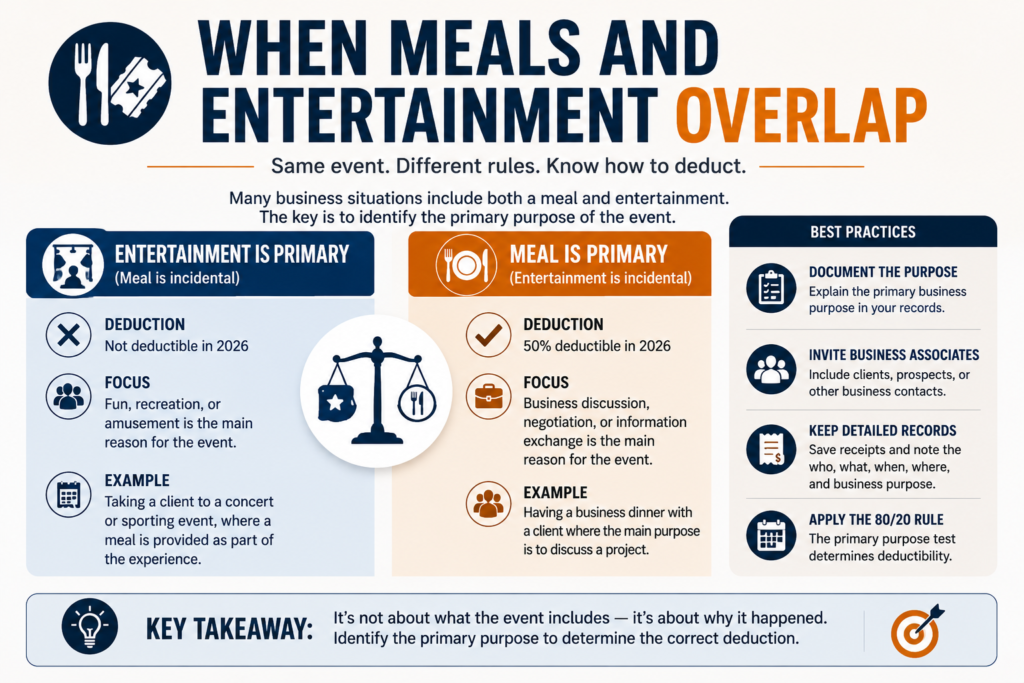
When Meals and Entertainment Overlap

business expenses

A common gray area is when a meal happens alongside an entertainment activity — for example, food and drinks at a sporting event. The key factor here is whether the cost of the food and beverages is separately stated from the entertainment cost on the invoice or receipt.

If the meal portion is broken out separately, that portion can still qualify for the 50% deduction, even though the entertainment portion remains nondeductible. If everything is bundled into one lump sum with no breakdown, the entire expense typically becomes nondeductible. This makes itemized receipts especially important whenever meals and entertainment are combined.

What Changed for 2026: Employer-Provided Meals

The most significant change taking effect in 2026 involves meals provided by employers for their own convenience — things like meals offered in an on-site cafeteria, catered meals during late-night work sessions, or snacks and meals once treated as routine workplace perks.

Through the end of 2025, these types of employer-provided meals were generally 50% deductible. Starting January 1, 2026, that deduction has been eliminated for most situations, meaning these costs are now 100% nondeductible unless a specific exception applies.

This is a meaningful shift for businesses that have historically offered free or subsidized meals to employees working long hours, whether through an office cafeteria, regular catered lunches, or stocked break rooms. Going forward, the tax treatment of these perks needs a second look — what used to generate a partial deduction may no longer generate any deduction at all.

What Still Remains Fully Deductible

What Still Remains Fully Deductible

Despite these tightening rules, several categories of meals and entertainment expenses remain 100% deductible in 2026:

  • Recreational and social events for employees. Costs for things like holiday parties, company picnics, or team celebrations primarily benefiting employees in general (not just highly compensated staff) remain fully deductible. Notably, a spouse or family member attending one of these events doesn’t disqualify the deduction — their presence is treated as part of the employee’s participation.
  • Meals treated as taxable compensation. If a meal’s value is included in an employee’s or contractor’s taxable income (reported on their W-2 or 1099), the cost remains fully deductible to the business.
  • Goods and services sold to customers. If your business sells food, beverages, or entertainment as part of its regular operations — for a restaurant or event venue, for example — those costs are treated as the cost of doing business, not as a meals and entertainment expense.
  • Expenses made available to the general public. Costs for things like an open house with refreshments, where the benefit isn’t limited to a specific group of employees or clients, generally remain deductible.

Recordkeeping Still Matters Most

Regardless of which category an expense falls into, the deduction depends on documentation. For every meal you plan to deduct, it’s worth keeping a record of who attended, the business purpose of the meeting, the date and location, and an itemized receipt — especially when meals are part of a larger bill that includes entertainment.

This is where digital receipt tools become valuable. Instead of relying on a stack of faded receipts at tax time, scanning and categorizing meal receipts as they happen — with notes on attendees and purpose — creates a clean audit trail. Apps like Manage Receipt let you capture this information in the moment, so when your accountant asks “what was this for?” months later, you already have the answer.

Setting Up for a Smoother 2026

Given how much these rules have shifted, it’s worth reviewing your current practices around employee meals, client entertainment, and company events before they pile up over the year. Set up separate expense categories in your bookkeeping for deductible meals, nondeductible entertainment, and the now-nondeductible employer-provided meals, so your books reflect the correct treatment from the start rather than requiring reclassification later. A short conversation with your accountant about how these changes specifically affect your business — particularly if you’ve historically offered on-site meals or snacks to employees — can help you adjust budgets and policies before the changes catch you off guard at tax time.

This article is for general informational purposes and isn’t a substitute for advice from a qualified tax professional, as rules can vary based on your specific business circumstances.

How ManageReceipt Makes Running Your Business With AI Easier

How ManageReceipt Makes Running Your Business With AI Easier

Whether you use a credit card or debit card, the real challenge is organizing proof.

Manage Receipt helps bridge that gap by ensuring every transaction has proper documentation.

With Manage Receipt, you can:

  •  Capture receipts instantly to prevent loss

  •  Store all receipts in one centralized system

  •  Access proof quickly for approvals and audits

  • Improve visibility into spending

  •  Reduce manual work and admin overhead

The biggest benefit of using ManageReceipt isn’t just the time you save. It’s the money you keep — because every receipt you capture is a deduction you can actually claim.

Try ManageReceipt free today — available on iOS and Android. No credit card required.

Click Here to know more about how Manage Receipt helps small businesses.

Frequently Asked Questions

Do I have to report my rideshare or delivery income if I didn't receive a 1099?

Yes. The IRS requires you to report all self-employment income regardless of whether you receive a 1099 form. Platforms typically issue a 1099-K if you earned $600 or more, but even if you earned below that threshold, your income is still taxable and must be reported on Schedule C.

Can I deduct mileage for driving to pick up my first passenger or delivery of the day?

Generally, the drive from your home to where you accept your first trip is considered a commute and is not deductible. However, once you are logged into the app and in "driver mode" looking for rides or deliveries, those miles may be deductible. Keeping your own mileage log from the moment you go online helps capture these miles accurately.

What records do I need to keep to support my mileage deduction?

The IRS requires a contemporaneous mileage log that includes the date of each trip, the starting and ending location, the total miles driven, and the business purpose. App data alone is often not enough because it only tracks on-trip miles. A dedicated mileage tracking app or a manual log updated after each driving session gives you the documentation you need if you are ever audited.
app screens

The Non-Negotiable: Get Your Finances in Order First

app screens

Every tool on this list helps you run your business better. But none of them matter if your financial records are a mess.

Before you invest in project management software, marketing tools, or e-commerce platforms — make sure your expense tracking is airtight. Every purchase you make for your business needs to be documented, categorised, and stored correctly. Not just for tax season, but for understanding whether your business is actually profitable.

That is exactly what ManageReceipt is built for. Scan a receipt in seconds, add the business purpose, and it is stored, backed up, and export-ready. No shoebox of crumpled paper. No scrambling at tax time.

Download ManageReceipt Free — Start Tracking Expenses Today
iOS & Android  |  managereceipt.com