



Airbnb expense tracking is essential for every short-term rental host who wants to maximize tax deductions and stay organized throughout the year. Running a short-term rental may seem simple until tax season arrives. Airbnb deposits money into your account, guests come and go, and expenses like cleaning fees, restocking supplies, platform commissions, mortgage interest, utilities, and repairs quickly pile up without proper records. Poor Airbnb expense tracking can lead to missed tax deductions, lost receipts, and unnecessary stress during an audit. This guide explains everything you need to know about Airbnb expense tracking, including the short-term rental tax deductions Airbnb hosts can claim, the best ways to organize receipts and expenses, and how to maintain accurate records all year long. Unlike salaried employees whose taxes are managed by an employer, Airbnb hosts are responsible for reporting rental income and documenting every deductible expense. The IRS allows hosts to claim a wide range of legitimate deductions, but these benefits are only available if you maintain proper records. A bank statement alone is not enough; keeping receipts and organized financial records is essential. Consistent Airbnb expense tracking also helps you understand your property’s true profitability while ensuring you remain audit-ready. If your property qualifies under the IRS 14-day rule, your rental income may be tax-free, but you won’t be able to claim rental deductions. Once you exceed that limit, your property is treated as a rental business, making Airbnb expense tracking even more important for accurate tax reporting and financial planning.

Most legitimate costs associated with running a short-term rental are deductible against rental income. These broadly fall into a few categories of Airbnb tax deductions:
Platform and transaction fees: Airbnb takes a service fee from every booking — typically around 3% for the host. These fees are deductible as a business expense. The same applies to any other booking platform you use, as well as payment processing fees.
Cleaning and maintenance: Professional cleaning between stays, cleaning supplies, laundry costs, and routine maintenance work all qualify. If you pay a cleaner per job or on a regular schedule, keep records of each payment — especially if they’re paid in cash.
Furnishings and supplies: Items purchased specifically for the rental — furniture, bedding, kitchen supplies, toiletries, decor — are deductible. Large furniture purchases may need to be depreciated over time rather than deducted in a single year, but smaller items (under $2,500 per item) can often be expensed immediately.
Utilities: If the rental is a separate property, utilities like electricity, water, gas, and internet are fully deductible during rental periods. If you rent part of your primary home, you’ll need to calculate the deductible portion based on square footage and time rented.
Insurance: A short-term rental policy, landlord insurance, or any umbrella coverage specifically for the property is deductible. Standard homeowner’s insurance generally isn’t — check with your insurer to make sure your policy actually covers short-term rentals.
Repairs and improvements: Repairs — fixing something that broke — are typically deductible in the year they happen. Improvements that add value to the property (a new kitchen, a deck addition) are usually depreciated over time. The line between the two matters, so keeping detailed records of what work was done and why helps.
Mortgage interest and property taxes: If the property is exclusively a rental, both are fully deductible. Mixed-use properties require a proportional calculation based on how many days the property was rented versus used personally.
Professional services: Accounting fees, legal fees related to the rental, and any consultants you hire for the property can be deducted. Even the cost of tax software used to file rental income returns qualifies.
Depreciation: The IRS allows you to depreciate a residential rental property over 27.5 years. This is one of the most significant deductions available to rental hosts — and one of the most commonly missed. You’ll need the original purchase price (minus land value) to calculate it. A tax professional can help you set this up correctly.

If you also use the property personally — even just a few weekends a year — you’re dealing with a mixed-use property. The IRS requires you to split deductions between personal use and rental use, based on the number of days the property was used for each purpose.
For example, if your property was available for 200 days during the year, you used it personally for 20 days, and guests stayed for 120 days, your rental use percentage is 60 percent (120 out of 200 days). That percentage applies to most of your deductions.
This calculation makes accurate rental record keeping even more important. You need to know exactly how many days the property was rented, how many days you occupied it personally, and how many days it was vacant or listed but unbooked. Airbnb’s dashboard gives you some of this data, but it doesn’t replace a proper expense log.
You don’t need complex accounting software to stay organized — but you do need a system. Here’s what works for most hosts:
Separate your finances: Open a dedicated bank account or credit card for rental income and expenses. When every transaction runs through one account, reconciling at tax time is far simpler. It also makes it immediately clear what belongs to the rental versus your personal finances.
Categorize expenses as they happen: Don’t wait until December to sort receipts. Each time you spend money on the rental, note what it was for. The major categories to track are platform fees, cleaning and supplies, utilities, maintenance and repairs, insurance, marketing (photography, listing upgrades), and capital improvements.
Capture receipts immediately: Paper receipts fade, get lost, or end up in pockets you forget about. Scanning them immediately — with a receipt management app or even a phone photo organized into folders — keeps a clean digital record. For expenses like contractor payments, create a simple paper trail even if it’s just an invoice with a note.
Track mileage if you visit the property: If your rental isn’t at your primary residence, every trip you make to manage it — for maintenance, cleaning checks, guest key handoffs — is potentially deductible mileage. The 2025 standard mileage rate for business use is 70 cents per mile. Even a few trips a month add up over a year.
Download your Airbnb statements monthly: Airbnb provides monthly income summaries that show gross bookings, platform fees, and net payouts. Download and save these each month rather than trying to reconstruct a full year at once. They’re available under Transaction History in your Airbnb account.

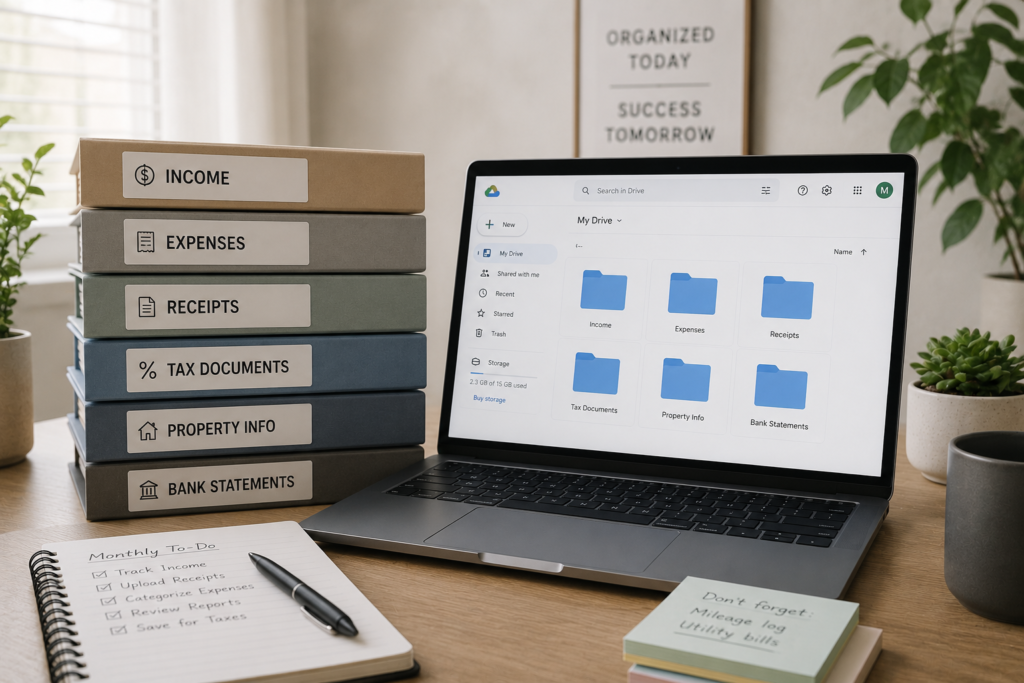
The IRS generally recommends keeping records for at least three years from the date you file your return — the standard audit window. For rental properties, longer is often better:
Digital storage makes long-term retention simple. Cloud-based receipt apps, scanned document folders, and downloaded platform statements take up no physical space and can be searched instantly when you need them.

The hosts who find tax season least stressful aren’t doing more work — they’re spreading the same work across the year instead of doing it all at once. A monthly habit of logging expenses, downloading income summaries, and reviewing your categories adds up to maybe 20 or 30 minutes a month. That’s far less painful than trying to reconstruct 12 months of spending in a weekend.
Short-term rental hosting is a business. Treating your finances accordingly — with a dedicated account, organized records, and consistent Airbnb expense tracking — doesn’t just make tax time easier. It gives you a clearer picture of what your property is actually earning, which expenses are growing, and whether your pricing is keeping up.
Whether you use a credit card or debit card, the real challenge is organizing proof.
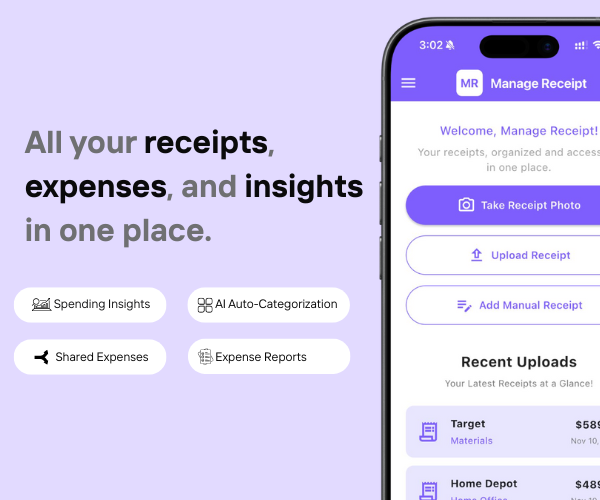
Manage Receipt helps bridge that gap by ensuring every transaction has proper documentation.
With Manage Receipt, you can:
Capture receipts instantly to prevent loss
Store all receipts in one centralized system
Access proof quickly for approvals and audits
Improve visibility into spending
Reduce manual work and admin overhead
The biggest benefit of using ManageReceipt isn’t just the time you save. It’s the money you keep — because every receipt you capture is a deduction you can actually claim.
Try ManageReceipt free today — available on iOS and Android. No credit card required.
Click Here to know more about how Manage Receipt helps small businesses.

Short-term rental income can be genuinely profitable — but only if you’re capturing the full deduction picture, not just reporting the income. For most hosts, the gap between what they could deduct and what they actually deduct comes down to one thing: records.
Building a simple, consistent system for Airbnb expense tracking isn’t complicated. It just has to happen throughout the year, not all at once when the deadline is looming. Start with a dedicated account, capture receipts as they happen, and review your numbers monthly. That’s really all it takes to go into tax season prepared rather than scrambling.

Every tool on this list helps you run your business better. But none of them matter if your financial records are a mess.
Before you invest in project management software, marketing tools, or e-commerce platforms — make sure your expense tracking is airtight. Every purchase you make for your business needs to be documented, categorised, and stored correctly. Not just for tax season, but for understanding whether your business is actually profitable.
That is exactly what ManageReceipt is built for. Scan a receipt in seconds, add the business purpose, and it is stored, backed up, and export-ready. No shoebox of crumpled paper. No scrambling at tax time.
Download ManageReceipt Free — Start Tracking Expenses Today
iOS & Android | managereceipt.com


© 2025 Manage Receipt. All Rights Reserved.
