Coworking Space Costs Deductible: Full 2026 Guide

Why Expense Tracking Matters More for Real Estate Agents

Agents are almost always self-employed. Most real estate agents work as independent contractors, even when affiliated with a brokerage. Therefore, expenses come straight out of your own pocket, with no employer reimbursement.

Income is commission-based and irregular. A slow month followed by a big closing makes budgeting hard. However, consistent expense tracking helps smooth out your estimated tax payments and shows a clearer picture of true profit.

Deductions directly increase what you keep. Every properly tracked expense lowers your taxable income. Consequently, agents who track diligently often keep thousands more each year than those who don’t.

Vehicle and Mileage Expenses

Vehicle and Mileage Expenses

Mileage is often the single biggest deduction for agents. Driving to showings, listing appointments, open houses, and client meetings adds up to significant mileage over a year.

Track every business trip, not just the big ones. Log the date, purpose, starting point, and mileage for each drive. Moreover, a mileage-tracking app removes the guesswork of reconstructing trips later.

You can choose between two deduction methods. The standard mileage rate multiplies your business miles by a flat rate, while the actual expense method tracks gas, insurance, repairs, and depreciation. Therefore, compare both to see which gives you a bigger deduction.

Marketing and Advertising Costs

Listing photography and videography are deductible. Professional photos, drone footage, and virtual tours for listings all count as business marketing expenses.

Signage, flyers, and print materials count too. Yard signs, open house flyers, and postcards mailed to a farm area are standard deductible marketing costs.

Digital ad spend and website costs qualify as well. Social media ads, listing platform boosts, and your website hosting or design fees are all deductible business expenses.

Licensing, Fees, and Professional Costs

Licensing, Fees, and Professional Costs

Board dues and MLS fees are fully deductible. These recurring costs are a standard part of doing business as a licensed agent.

License renewal and continuing education count too. State license renewal fees and required continuing education courses are deductible professional expenses.

Errors and omissions insurance is deductible. This coverage protects your business, and the premium is treated the same as other business insurance costs.

Home Office and Workspace Costs

A dedicated home office space can qualify. If you have a space used regularly and exclusively for business, from prepping listings to following up with leads, it may qualify for a home office deduction.

Office supplies and equipment are deductible. Printer ink, a laptop used for business, contract folders, and similar supplies count as ordinary business expenses.

Software subscriptions add up quickly. CRM tools, e-signature platforms, and transaction management software are all deductible business tools.

Let Manage Receipt Handle the Busy Season

Let Manage Receipt Handle the Busy Season

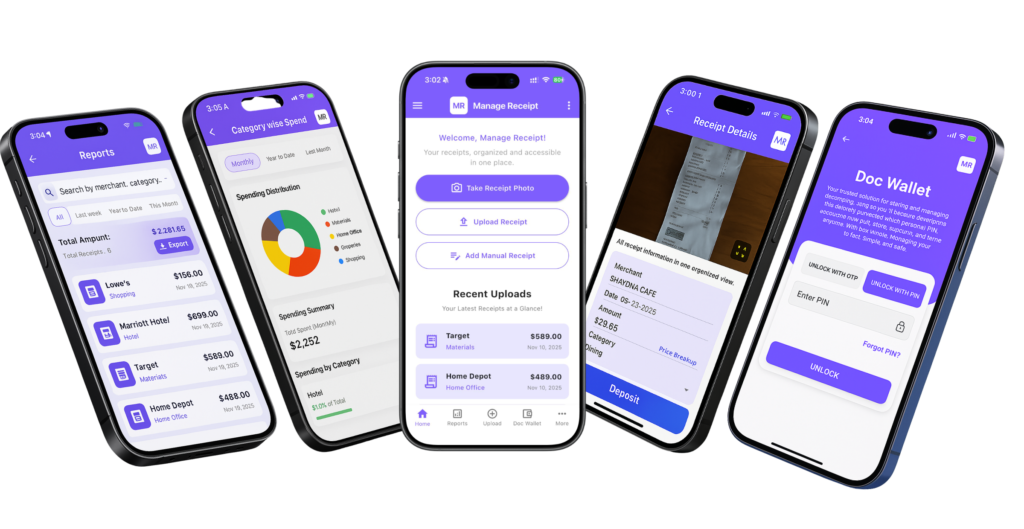
Manage Receipt scans and categorizes every real estate expense the moment you photograph it, from staging invoices to MLS dues. Therefore, you can focus on showings and closings instead of chasing paper receipts. Additionally, your records stay organized and ready to hand off to your accountant at tax time.

With Manage Receipt, you can:

  • Upload and organize receipts in one secure place
  •  Keep digital proof for long-term access
  • Track spending and manage expenses easily
  • Maintain digital records for accounting and budgeting


Conclusion

paper-less receipt

Real estate agents lose more in unclaimed deductions than almost any other self-employed profession, simply because expenses are scattered across mileage, marketing, staging, and licensing all at once. The fix isn’t complicated: photograph every receipt the same day, separate business spending from personal, and review your numbers monthly instead of once a year.

Get that habit in place, and tax season stops being a scramble through a shoebox of faded receipts. Instead, it becomes a quick export of records you’ve already been keeping organized all along.

paper-less receipt

FAQs

Can real estate agents deduct clothing for showings?

Generally, no. Everyday professional clothing doesn't qualify, even if worn primarily for work. However, clothing required exclusively for a specific business purpose, like branded uniforms, may be treated differently.

Do I need a separate bank account for real estate expenses?

It's not required, but it's strongly recommended. A separate account makes it much easier to track deductible expenses and avoid mixing personal and business spending.

Can I deduct both mileage and vehicle depreciation?

No. You must choose either the standard mileage rate or the actual expense method, which includes depreciation, for a given vehicle each year. Consequently, compare both to see which delivers the larger deduction.

Smart app for organizing receipts and expenses.

Manage Receipt is designed to simplify the way individuals and businesses manage their financial records. The app allows users to digitize receipts, organize expenses, and generate reports in one platform. With smart tools like receipt scanning, expense tracking, and bill reminders, users can easily monitor their spending and keep their financial data organized.