



Home office tax deduction claims are only as strong as the records behind them. Claiming a dedicated workspace may seem simple until tax season arrives and the IRS asks for proof. Utility bills, repair receipts, mortgage or rent statements, and photos of the space quickly pile up without a system. Poor home office tax deduction records can lead to a denied claim, lost receipts, and unnecessary stress during an audit. This guide explains everything you need to know about the home office tax deduction, including who qualifies, how to calculate it using the simplified or actual expense method, and how to keep records that hold up if you’re ever reviewed.


Once you know which method you’re using, the next question is which costs actually qualify. If you use the actual expense method, these are the main categories of home office tax deduction expenses to track:
Mortgage interest or rent: Whether you own or rent, this is usually the largest expense in the calculation. You apply the business-use percentage of your home (based on square footage) to your total mortgage interest or rent paid for the year.
Utilities: Electricity, gas, water, trash, and internet are all deductible in proportion to your business-use percentage. If you have a dedicated business phone or internet line, that can often be deducted in full instead.
Homeowners or renters insurance: The portion of your annual insurance premium that corresponds to your home office percentage is deductible. If you carry a separate rider for business equipment, that portion is deductible as well.
Repairs and maintenance: Repairs to the home office itself — a fresh coat of paint, a repaired window, an HVAC repair that serves the whole home — are deductible either in full (if the repair is specific to the office) or at your business-use percentage (if it benefits the whole home).
Real estate and property taxes: Like mortgage interest, property taxes are prorated using your business-use percentage and added to the deduction.
Depreciation: If you own your home and use the actual expense method, you can depreciate the business-use portion of the home’s value over time. This is one of the most valuable parts of the deduction — and one of the most commonly missed, since it requires a bit more calculation up front.
Furniture and equipment: A desk, chair, filing cabinet, or business-only computer used exclusively in the office can typically be deducted in full, separately from the home office calculation itself, since these are ordinary business expenses rather than home expenses.
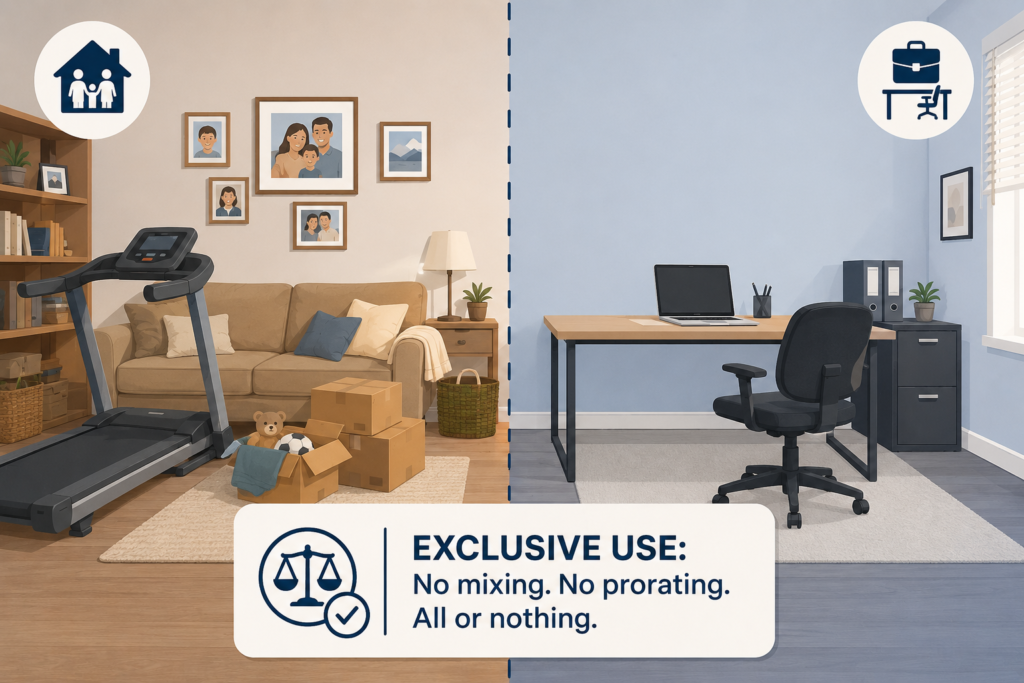
Unlike a mixed-use rental property, a home office doesn’t get to prorate between personal and business use. This is the single biggest difference between how the IRS treats a short-term rental and how it treats a home office, and it trips up more people than any other rule.
If a room is used mostly for business but still doubles for something personal — a home office that also stores the holiday decorations or the family treadmill — the IRS doesn’t let you deduct a percentage of that room the way an Airbnb host would prorate rental days. The exclusive-use test is all or nothing: either the space is used only for business, or the whole deduction is disqualified.
There’s one narrow exception: licensed home daycare providers. Because a daycare realistically shares the same living room or playroom with family use throughout the day, the IRS allows a time-based percentage instead of requiring exclusive use.
For everyone else, the fix is simple but requires discipline: pick a room, a converted closet, or a clearly partitioned section of a room, and keep it business-only — in practice, not just on paper. A door, a curtain, or a permanent divider makes this easy to prove if it’s ever questioned.


You don’t need complex accounting software to stay organized — but you do need a system. Here’s what works for most freelancers and small business owners claiming the home office deduction:
Measure and document your space: Before anything else, get the exact square footage of your office and the total square footage of your home. Take a photo or sketch a quick floor plan showing the space is clearly defined and separate. This is your proof for the exclusive-use test if it’s ever questioned.
Categorize expenses as they happen: Don’t wait until April to sort through a year of bills. Each time a home expense comes in, note which category it belongs to — mortgage interest or rent, utilities, insurance, repairs, or depreciation — so your records are already organized by the time you calculate the deduction.
Capture receipts immediately: Paper receipts fade, get lost, or end up in a drawer you forget about. Scanning them immediately — with a receipt management app or even an organized phone photo — keeps a clean digital record for furniture, equipment, and repair purchases tied to the office.
Save your monthly statements separately: Keep mortgage or rent statements, utility bills, and insurance statements in one folder as they arrive each month, rather than trying to track them down from a full year of email at tax time.
Revisit your calculation every year: If your square footage changes, or your home expenses shift significantly, redo the comparison between the simplified and actual expense methods instead of defaulting to whatever you used last year.

No matter which method you choose, documentation is non-negotiable. You should keep a simple floor plan or photo showing the square footage and layout of the office, utility bills, mortgage or rent statements, and insurance statements for the actual expense method, receipts for repairs or furniture tied to the space, and a record of the date you started using the space regularly for business.
This is where most freelancers fall behind — not because the deduction is complicated, but because the receipts and bills that support it get lost in inboxes, drawers, and text message photos. Scanning and tagging every home-office-related receipt as it comes in, rather than hunting for it in April, is what makes this deduction stress-free at tax time.

Most home office deductions don’t get denied because the claim was wrong — they get denied because nobody could produce the paperwork two years later when the IRS finally asked. A repair receipt from March, a utility bill from August, a photo of the office taken the day you set it up: none of it feels urgent to save in the moment, and all of it becomes hard to reconstruct once the year is over.
The fix isn’t a bigger effort at tax time, it’s a smaller effort built into the year. Save the bill the day it arrives. Photograph the receipt the day you buy the chair. Note the date if anything about the space changes. By the time your accountant asks for backup, you’re handing over a folder instead of trying to remember what happened eleven months ago.
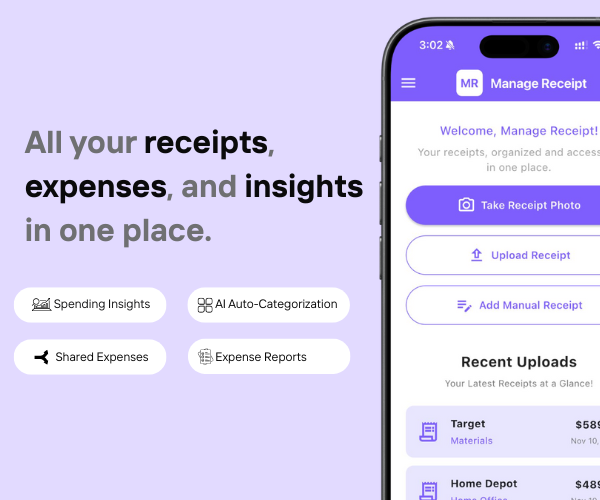
Whether you use a credit card or debit card, the real challenge is organizing proof.
Manage Receipt helps bridge that gap by ensuring every transaction has proper documentation.
With Manage Receipt, you can:
Capture receipts instantly to prevent loss
Store all receipts in one centralized system
Access proof quickly for approvals and audits
Improve visibility into spending
Reduce manual work and admin overhead
The biggest benefit of using ManageReceipt isn’t just the time you save. It’s the money you keep — because every receipt you capture is a deduction you can actually claim.
Try ManageReceipt free today — available on iOS and Android. No credit card required.
Click Here to know more about how Manage Receipt helps small businesses.

The home office tax deduction is one of the most reliable ways to lower what you owe — but only if the space qualifies and the paperwork exists to prove it when someone asks.
Choosing between the simplified method and the actual expense method comes down to your square footage and your actual home costs, not whichever one is easier to remember at tax time.
But regardless of which method you use, one thing stays constant: accurate records, kept as the year happens, decide whether the deduction survives a second look.
With a system like Manage Receipt, freelancers and small business owners can capture receipts, store home office documentation, and stay ready for whatever tax season — or an audit — asks for.

Every tool on this list helps you run your business better. But none of them matter if your financial records are a mess.
Before you invest in project management software, marketing tools, or e-commerce platforms — make sure your expense tracking is airtight. Every purchase you make for your business needs to be documented, categorised, and stored correctly. Not just for tax season, but for understanding whether your business is actually profitable.
That is exactly what ManageReceipt is built for. Scan a receipt in seconds, add the business purpose, and it is stored, backed up, and export-ready. No shoebox of crumpled paper. No scrambling at tax time.
Download ManageReceipt Free — Start Tracking Expenses Today
iOS & Android | managereceipt.com


© 2025 Manage Receipt. All Rights Reserved.
