



What triggers a small business audit is something every business owner should understand — before the IRS comes asking.
The IRS doesn’t select businesses by accident. It uses a sophisticated scoring system that compares your return against thousands of similar businesses in your industry and income range.
When your numbers look unusual compared to industry averages — even if every expense is legitimate — your return gets flagged for closer review. A small business audit can be triggered by something as simple as deductions that look too high compared to what similar businesses report.
Beyond the scoring system, returns also get pulled when 1099s don’t match what you reported, when a business partner or vendor you work with gets audited, or when a tip is filed by a former employee or competitor.
The good news: most small business audit triggers are completely avoidable with the right habits. The businesses that get audited and walk away clean aren’t the ones with perfect returns — they’re the ones with perfect records.

Claiming unusually high deductions: The IRS compares your deductions against industry averages. If yours are significantly higher than similar businesses — even if legitimate — your return gets flagged immediately.
Reporting losses 3+ years in a row: Your business may get reclassified as a hobby, which means none of your deductions are allowed. Keep records showing a genuine profit motive.
Claiming 100% vehicle business use: This is deeply suspicious to the IRS. Almost no vehicle is used exclusively for business. Track actual business mileage and claim the accurate percentage instead.
Home office deductions: Only qualifies for a space used regularly and exclusively for work. A dining table where you occasionally answer emails does not qualify.
Misclassifying employees as contractors: If the IRS determines workers should have been employees, you may owe back payroll taxes, penalties, and interest.
Excessive meal and entertainment expenses: Every meal deduction needs documentation — who attended, the business relationship, and what was discussed.
Unreported income: The IRS receives copies of every 1099 issued to you. If the numbers don’t match what you reported, it’s flagged automatically.
Round-number deductions: Exactly $5,000 for supplies or precisely $10,000 for travel suggests estimation, not real tracking. Real expenses produce irregular, specific numbers.
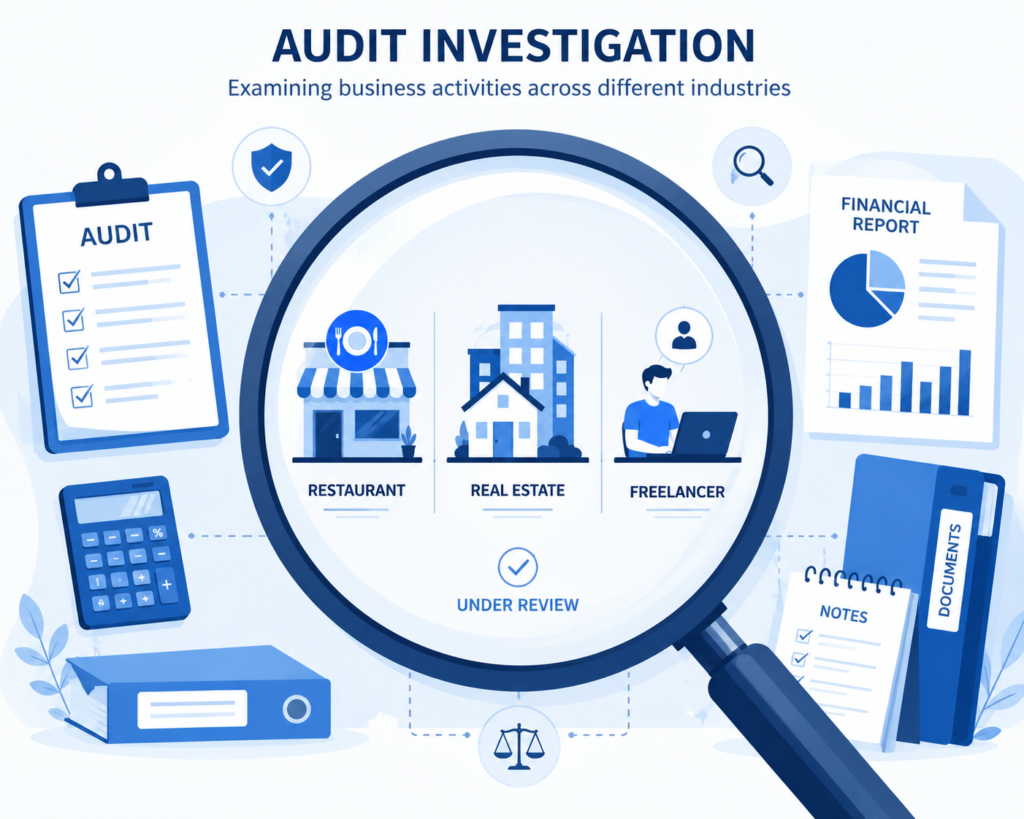
Some business types attract disproportionate audit attention because of historically higher rates of underreporting. If your business falls into one of these categories, your documentation needs to be tighter than average:
Cash-heavy businesses: Restaurants, salons, retail shops, food trucks, and any business where a significant portion of revenue arrives in cash are among the most audited business types in the country.
Real estate professionals: Complex depreciation rules, mixed-use properties, and passive loss rules create frequent errors that the IRS actively looks for.
Self-employed individuals on Schedule C: Particularly those with high deductions relative to income — the higher the ratio, the more the return stands out.
Gig economy workers: The IRS has significantly increased focus on income from platforms like Uber, Airbnb, Etsy, and similar marketplaces where underreporting is common.
High-income earners: Returns above $200,000 in annual income are audited at a significantly higher rate than the national average.

Most audits are avoidable. The businesses that sail through them cleanly aren’t the ones with perfect returns — they’re the ones with perfect records. Here’s what to do right now:
Keep every receipt — not just the big ones: Small expenses add up, and missing receipts for even minor deductions create gaps. A receipt management system that captures every expense automatically is the most practical protection available.
Separate personal and business finances completely: A dedicated business bank account and credit card eliminates the most common audit trigger. When every transaction is clearly business-related, your records are immediately stronger.
Document the business purpose of every deduction: A receipt shows an amount. A note shows why it was a business expense. For meals, note who you met and what you discussed. For travel, note the business purpose. This context turns a receipt into a defensible deduction.
Track mileage with a proper log: If you claim vehicle expenses, maintain a log with the date, destination, and business purpose of every trip. A contemporaneous log recorded at the time is far more credible than one reconstructed months later.
File accurately and on time: Late filings and amended returns attract additional scrutiny. Filing correctly the first time is always better than correcting later.
Keep records for at least 7 years: The standard audit window is 3 years, but if the IRS suspects underreported income it extends to 6. Seven years is the safe standard for most small businesses.


Most small business audits are not the dramatic investigations people imagine. The majority are correspondence audits — the IRS sends a letter asking for documentation to support a specific item. You respond with records, and the matter is resolved without any face-to-face meeting.
Correspondence audit: The most common type. The IRS sends a letter requesting documentation for one specific item. Respond with the right records and it’s typically resolved quickly.
Office audit: You’re asked to bring documents to a local IRS office. More serious than a correspondence audit but still focused on specific issues rather than your entire return.
Field audit: An IRS agent visits your place of business. This is the most comprehensive type and usually covers multiple years and multiple line items simultaneously.
The burden of proof is on you: The IRS doesn’t have to prove you were wrong. You have to prove you were right — with documentation. Clean organized records are the difference between a quick resolution and a lengthy, costly process.

The businesses that go through audits with minimal disruption aren’t the ones with perfect returns — they’re the ones with perfect records. And perfect records don’t happen in April. They’re built month by month, receipt by receipt, throughout the year.
A monthly habit of capturing expenses, categorizing receipts, and reviewing your records adds up to maybe 20 to 30 minutes a month. That’s far less painful than trying to reconstruct a full year of spending when an IRS audit notice arrives.
The most effective audit-prevention practice any small business owner can build is simple: capture every receipt the moment a purchase happens, add a quick note about the business purpose, and store it digitally where it can be searched instantly.
Every receipt you capture today is one less problem if the IRS comes asking. Manage Receipt makes this effortless — scan, categorize, and store every business expense automatically, so whether you need records next week or three years from now, they’re always ready.
Whether you use a credit card or debit card, the real challenge is organizing proof.
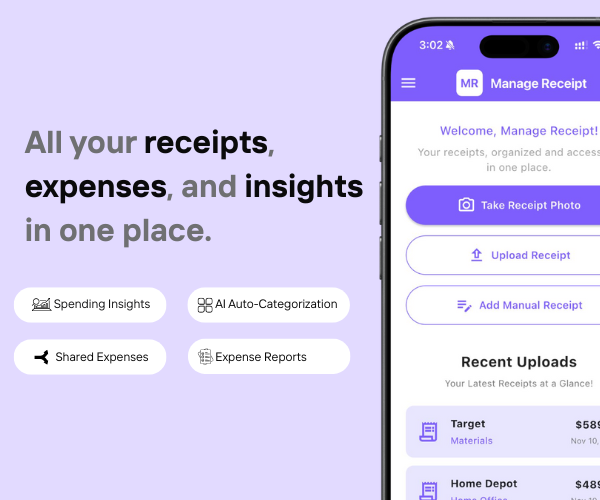
Manage Receipt helps bridge that gap by ensuring every transaction has proper documentation.
With Manage Receipt, you can:
Capture receipts instantly to prevent loss
Store all receipts in one centralized system
Access proof quickly for approvals and audits
Improve visibility into spending
Reduce manual work and admin overhead
The biggest benefit of using ManageReceipt isn’t just the time you save. It’s the money you keep — because every receipt you capture is a deduction you can actually claim.
Try ManageReceipt free today — available on iOS and Android. No credit card required.
Click Here to know more about how Manage Receipt helps small businesses.

A small business audit is not inevitable — and for most businesses that keep clean records and file accurately, it’s unlikely. But the protection isn’t just in filing correctly. It’s in having the documentation to prove it.
Every receipt you capture, every mileage entry you log, every business expense you categorize at the time it happens is a building block of an audit-ready record. The businesses that go through audits with minimal disruption aren’t the ones with perfect returns — they’re the ones with perfect records.
Audit triggers are mostly avoidable. Red flags are equally fixable. And the habit that protects you most capturing every expense the moment it occurs — costs almost no extra time when done consistently. Start now, even mid-year. Every receipt captured today is one less problem if the IRS ever comes asking.

Every tool on this list helps you run your business better. But none of them matter if your financial records are a mess.
Before you invest in project management software, marketing tools, or e-commerce platforms — make sure your expense tracking is airtight. Every purchase you make for your business needs to be documented, categorised, and stored correctly. Not just for tax season, but for understanding whether your business is actually profitable.
That is exactly what ManageReceipt is built for. Scan a receipt in seconds, add the business purpose, and it is stored, backed up, and export-ready. No shoebox of crumpled paper. No scrambling at tax time.
Download ManageReceipt Free — Start Tracking Expenses Today
iOS & Android | managereceipt.com


© 2025 Manage Receipt. All Rights Reserved.
