
Expense Tracking for Etsy Sellers: What's Deductible and How to Track It

Why Etsy Sellers Must Track Expenses

An Etsy seller working at a tidy desk with handmade product samples, shipping boxes, receipts, a laptop, and a calculator, organizing inventory and tracking business finances in a warm, well-lit home workspace.

If you’re running an Etsy shop, you’re running a business. And if you’re running a business, the IRS expects you to track your expenses and report them accurately on your tax return.

Most Etsy sellers get one of two things wrong: they either track too much (claiming personal expenses as business costs) or they track too little (missing hundreds or thousands in legitimate deductions).

An Etsy seller who makes $50,000 in sales but has $25,000 in business expenses only pays taxes on $25,000 of income. The difference between tracking expenses and not tracking them can mean paying $5,000 to $10,000 more in taxes than you should.

An Etsy seller working at a tidy desk with handmade product samples, shipping boxes, receipts, a laptop, and a calculator, organizing inventory and tracking business finances in a warm, well-lit home workspace.

What Etsy Business Expenses Are Deductible

What Etsy Business Expenses Are Deductible

What Etsy Business Expenses Are Deductible

  • Supplies and materials: Everything you buy specifically to create products for your shop is deductible — fabric, beads, wood, resin, paint, thread, packaging materials, labels, tags, and anything else that goes into making your products. Keep receipts for all supply purchases, no matter how small they seem.
  • Etsy fees and transaction costs: Etsy charges listing fees (20 cents per listing), transaction fees (6.5% of the sale price), and payment processing fees. These are deductible as business expenses. Download your Etsy payment statements monthly.
  • Shipping and postage: Every penny you spend on shipping supplies and postage is deductible. This includes boxes, bubble wrap, tissue paper, tape, labels, and the actual shipping costs. Track shipping costs separately — they’re one of the largest deductions for Etsy sellers.
  • Photography and product photos: If you pay for product photography, a photographer’s time, or a light box and props for taking photos, these are deductible. Even editing software like Lightroom or Photoshop is also deductible.
  • Website and platform tools: Subscriptions to tools that help you run your shop are deductible. This includes Etsy shop customization apps, email marketing software, Instagram scheduling tools, SEO apps.
  • Home office: If you have a dedicated space where you pack orders, photograph products, or manage your shop, you may qualify for a home office deduction.
  • Shipping container subscriptions and bulk purchases: If you subscribe to a box service for packaging materials or buy supplies in bulk from wholesale suppliers, these are fully deductible business expenses.
  • Mileage and vehicle expenses: Every trip to the craft store, the post office, or a supplier is potentially deductible mileage.
  • Equipment and tools: Items purchased specifically for your Etsy shop are deductible. This includes sewing machines, cutting machines, heat presses, kilns, jewelry-making tools.
  • Professional development: Courses about Etsy optimization, business skills, marketing, or craft techniques are deductible if directly related to running your shop.

Expenses That Are NOT Deductible for Etsy Sellers

Not everything you spend money on counts as a business expense. The IRS has clear rules about what doesn’t qualify:

  • Personal supplies mixed with business supplies — if you buy a box of thread and half goes to your hobby projects, only the business half is deductible
  • Meals and entertainment unless directly related to a business discussion
  • General household expenses like rent, utilities, or internet if not allocated specifically to business use
  • Personal development that isn’t directly business-related
  • Gifts to family members or personal friends
  • Items you buy for personal use, even if you sometimes use them for photos
  • Travel expenses unless the primary purpose of the trip is business

How to Set Up an Etsy Expense Tracking System

How to Set Up an Etsy Expense Tracking System

The difference between sellers who maximize deductions and those who don’t comes down to one thing: organization. Here’s how to build a system that actually works:
  • Use a dedicated business bank account and credit card: Open a separate bank account for Etsy income and all business expenses. Use a dedicated credit card for supplies and business purchases. This single step makes everything else easier.
  • Download Etsy payment statements monthly: Go to your Etsy Shop Manager, find “Finances,” and download your monthly payment statement. Save these files organized by month and year.
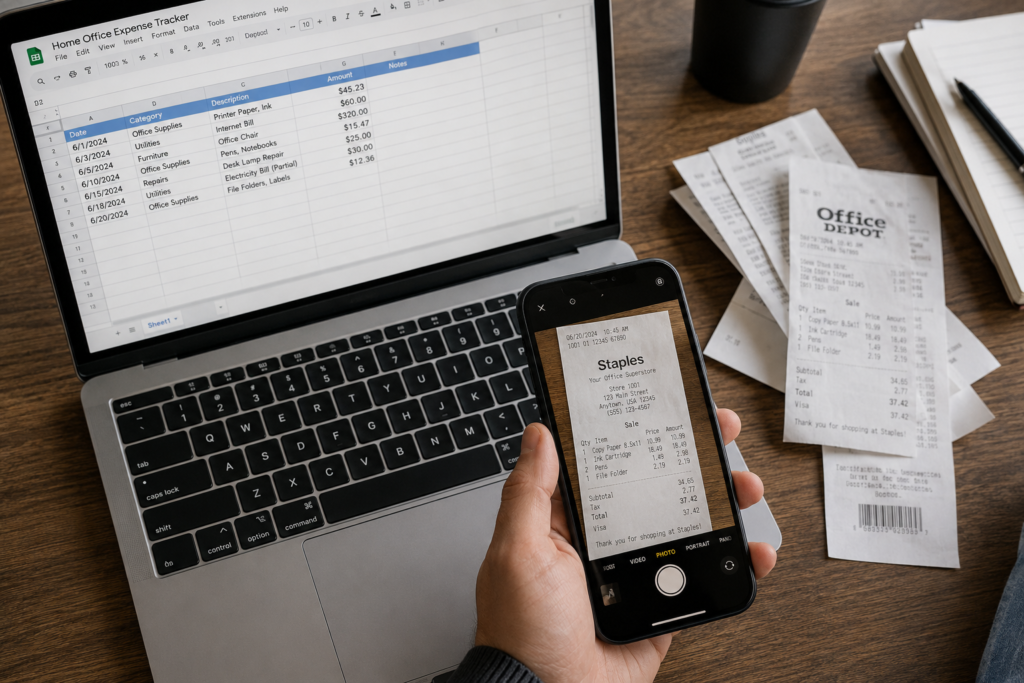
  • Capture receipts for everything: Every supply purchase, tool, app subscription, and shipping cost needs a receipt. Take photos or scans of physical receipts the moment you get them. A receipt management app that captures everything automatically is the most practical system.
  • Categorize expenses as you spend: Create categories like: Supplies, Shipping, Fees, Equipment, Software, Mileage, and Home Office. When you buy something, note which category it belongs to right away.
  • Track mileage with a log: Keep a mileage log for trips to suppliers, the post office, and shipping locations. Record the date, destination, purpose, and miles driven.
  • Review monthly: Once a month, spend 15 minutes reviewing your expenses. Reconcile your credit card statement against your receipts.

Common Etsy Seller Expense Tracking Mistakes

  • Mixing personal and business purchases on the same credit card
  • Losing receipts for small supplies — they add up to hundreds across the year
  • Forgetting to track Etsy fees — they’re taken out before you’re paid
  • Claiming 100% personal expenses as business because they’re used occasionally
  • Not tracking mileage to suppliers and the post office
  • Forgetting about app subscriptions and software
  • Waiting until tax time to organize everything
  • Not documenting the business purpose of equipment purchases

How Long to Keep Etsy Business Records

How Long to Keep Etsy Business Records

The IRS standard is three years from the date you file your return. But some records should be kept longer to protect yourself:

  • Annual expense summaries and Etsy payment statements: 7 years — Keep these organized by year. They show your sales, fees, and deposits clearly.
  • Equipment receipts: 7 years past when the item is fully depreciated — If you bought a sewing machine for $2,000 and depreciate it over 5 years, keep the receipt for 12 years total.
  • Mileage logs: 3 years from filing — A contemporaneous log (recorded when the trip happens) is far more credible than one reconstructed later.
  • Shipping records and supply receipts: 3 years — Keep these to back up your expense categories.

Digital storage makes this simple. Organize your receipts and statements by year in a cloud folder. They take up almost no space and can be searched instantly. Never lose a receipt to time or damage again.
Estimated Taxes for Etsy Sellers

5 Tips for Filing Small Business Taxes for the First Time | Beginner Guide

Quarterly estimated taxes are one of the most overlooked responsibilities for Etsy sellers. Many sellers are shocked in April when they realize they owe a large tax bill because they didn’t plan for quarterly payments throughout the year.

Here’s the practical approach: Set aside 20-30% of every Etsy deposit into a separate savings account. Don’t touch this money. When quarterly payment dates arrive (April 15, June 15, September 15, and January 15), you already have the funds ready. This prevents scrambling and keeps you compliant with IRS requirements.

The sellers who stay on top of their taxes aren’t the ones stressed in January — they’re the ones who planned and paid throughout the year. Start tracking expenses and setting money aside today, and you’ll never face an unexpected tax bill again.
5 Tips for Filing Small Business Taxes for the First Time | Beginner Guide

How ManageReceipt Makes Running Your Business With AI Easier


How ManageReceipt Makes Running Your Business With AI Easier


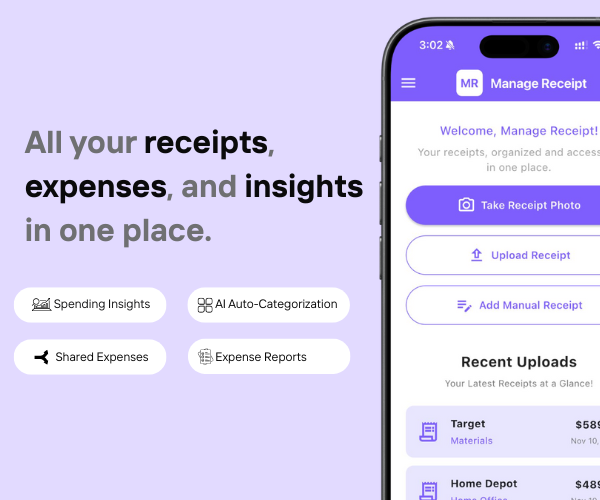
Do you use a credit card or debit card for business? The real problem is not spending. It is keeping track of every receipt.

Manage Receipt fixes that. It makes sure every purchase has the right proof attached to it.

With Manage Receipt, you can:

  • Capture receipts right away so you never lose them
  • Keep all receipts in one place
  • Find proof fast when you need it for approvals or audits
  • See exactly where your money goes
  • Cut down on paperwork and admin tasks

The biggest win? It is not just the time you save. It is the money you keep. Every receipt you save is a tax deduction you can actually use.

Try ManageReceipt free today. It works on iOS and Android. No credit card needed.

Click Here to learn more about how Manage Receipt helps small businesses.

Conclusion

Etsy sellers who track expenses properly don’t just reduce their tax bill — they gain clarity about what their business actually costs to run. You’ll know whether you’re pricing your products correctly, whether certain products are profitable, and where your money is actually going.

The habit of capturing every expense the moment it happens, with a note about its business purpose, is the foundation of a healthy Etsy business. It costs almost no extra time when done consistently — and it’s worth thousands at tax time.

Start today, even if you’ve been operating your Etsy shop for years without tracking. Every receipt you capture from this point forward is money back in your pocket at tax time.

Frequently Asked Questions

When can I start deducting Etsy business expenses?

You can start deducting business expenses from the moment you open your Etsy shop and begin selling. If you purchased equipment or supplies before your first sale, those expenses are still deductible — they're part of your business startup costs. Keep receipts for everything purchased with the intent to start your shop. You don't need to wait until your first sale to begin tracking; expenses incurred before launch count as legitimate business costs that reduce your taxable income.

What if I didn't track expenses for the past year? Can I still deduct them?

It's harder, but not impossible. If you can find bank statements, credit card statements, or Etsy payment records that show purchases, the IRS may accept those as proof of expenses. However, a contemporaneous record (kept at the time) is far more credible than one reconstructed later. Going forward, start tracking today. For past years, consult with a tax professional about what you can reasonably reconstruct and claim. The best time to start tracking was last year; the second best time is today.

How do I prove my Etsy expenses to the IRS if I get audited?

Keep three things for each expense: (1) A receipt showing what you bought and the cost, (2) A bank or credit card statement proving it was a business purchase, and (3) A note about the business purpose. For subscriptions, save confirmation emails. For supplies, photograph receipts. For mileage, keep a simple log with dates and destinations. Organized records are your best defense during an audit. A receipt management app like Manage Receipt makes this automatic — scan, categorize, and you're audit-ready.
app screens

The Non-Negotiable: Get Your Finances in Order First

app screens

Every tool on this list helps you run your business better. But none of them matter if your financial records are a mess.

Before you invest in project management software, marketing tools, or e-commerce platforms — make sure your expense tracking is airtight. Every purchase you make for your business needs to be documented, categorised, and stored correctly. Not just for tax season, but for understanding whether your business is actually profitable.

That is exactly what ManageReceipt is built for. Scan a receipt in seconds, add the business purpose, and it is stored, backed up, and export-ready. No shoebox of crumpled paper. No scrambling at tax time.

Download ManageReceipt Free — Start Tracking Expenses Today
iOS & Android  |  managereceipt.com