


Underpricing is one of the most common and most damaging mistakes small business owners make. It usually starts with good intentions — keeping prices low to attract clients, to stay competitive, to avoid the awkwardness of asking for more — but it compounds over time.
When your prices don’t keep up with your costs, your margins shrink. You take on more work to compensate. You burn out. You attract clients who chose you primarily because you were cheap, which makes them the first to leave.
Undercharging doesn’t just hurt your income — it affects your perception in the market. Price is one of the primary signals buyers use to judge quality. Clients who pay more tend to value the service more and stay longer.
The business owners who raise prices regularly and confidently — small increases, consistently — rarely lose clients over it. The ones who avoid it for years and then make a large sudden jump are the ones who create disruption.

Your costs have increased: Rent, supplies, software subscriptions, contractor rates — if your operating costs have gone up and your prices haven’t moved, your real margin is shrinking every month.
You’re booked out or turning away work: When demand exceeds your capacity, your price is too low. A price increase filters for clients most willing to pay and improves your margin.
You haven’t raised prices in over a year: Inflation alone erodes the value of a flat price. A small annual increase — even 3 to 5 percent — keeps you from falling behind.
You’ve added skills or experience: If you’re delivering noticeably better work than two years ago, your price should reflect that.
Your best clients would pay more: Value-focused clients rarely complain about price increases — they’re paying for results, not the lowest rate.
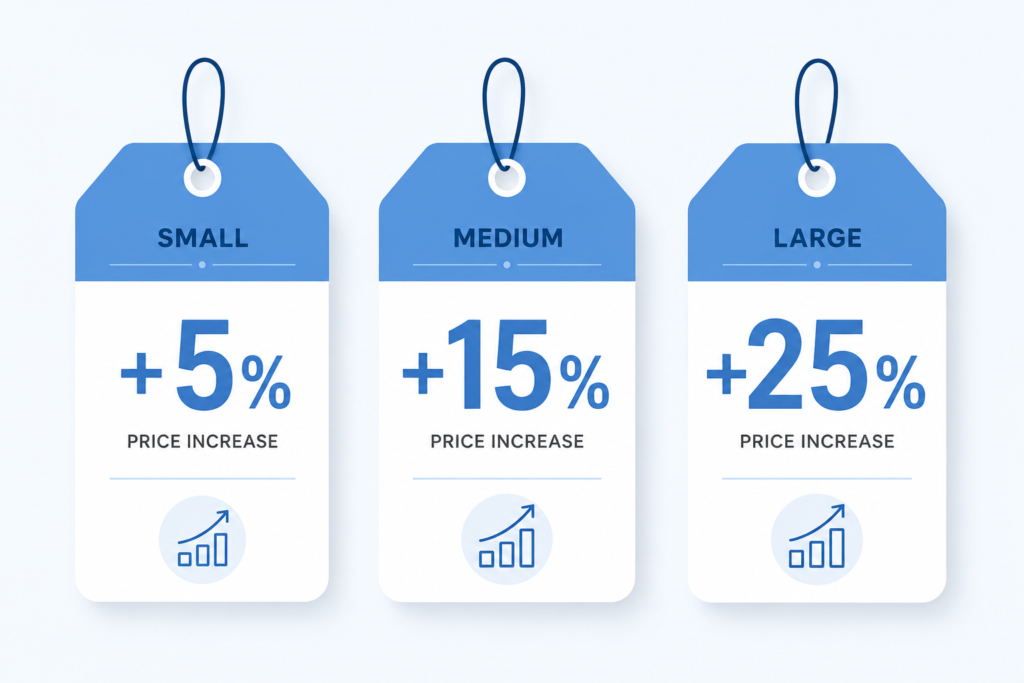
There’s no single rule, but these three frameworks help small business owners make the right call:
Annual inflation adjustment (3–5%): The most painless approach. A small annual increase applied consistently keeps your prices current without ever requiring a large disruptive jump. Most clients barely notice a 3 to 5 percent increase, especially if your communication is clear and your service is solid.
Market rate correction (10–20%): If you’ve fallen significantly behind market rates — either because you’ve undercharged from the start or haven’t raised prices in years — a larger correction may be necessary. Check what comparable providers in your area are charging. If you’re 20 percent below market, a 10 percent increase still leaves you below market and is hard for clients to object to.
Value-based repositioning (20%+): If you’re making a deliberate shift — upgrading your positioning or targeting higher-value clients — a larger price jump may be appropriate. This often involves accepting some client attrition as part of the strategy.

The way you communicate a price increase matters almost as much as the increase itself. Done poorly, it creates resentment. Done well, most clients accept it without issue:
Give notice in advance: Don’t spring a price increase at the next invoice. Give clients at least 30 days notice — 60 days is better for long-term clients. This respects the relationship and signals confidence.
Be direct, not apologetic: An apologetic, over-explained message invites pushback. A clear, confident message signals this is a normal business decision — because it is.
Acknowledge the relationship: For long-term clients, a personal touch goes a long way. Let them know you value the relationship and wanted to communicate the change directly rather than just updating an invoice.
Give existing clients a grace period: For your best clients, holding their current rate for one or two more billing cycles before the new rate kicks in generates significant goodwill.
Don’t negotiate against yourself: Once you’ve communicated a price increase, don’t immediately offer to undo it at the first sign of hesitation. Hold the position — caving immediately signals the increase wasn’t serious.


Most clients won’t push back at all. A reasonable increase, communicated well, is accepted as a normal part of doing business. The clients most likely to push back are those who chose you primarily on price or who have the longest relationship and feel entitled to the old rate.

Many business owners find it easier to raise prices for new clients first — list the new rate on your website or proposals, and let it apply to all new business. Existing clients stay on their current rate temporarily while you plan the transition.
This creates a natural proof point: once you’ve successfully onboarded new clients at the higher rate, you have real evidence the market accepts it. That makes the conversation with existing clients easier — you’re not speculating about whether people will pay more, you know they will.
Whether you use a credit card or debit card, the real challenge is organizing proof.
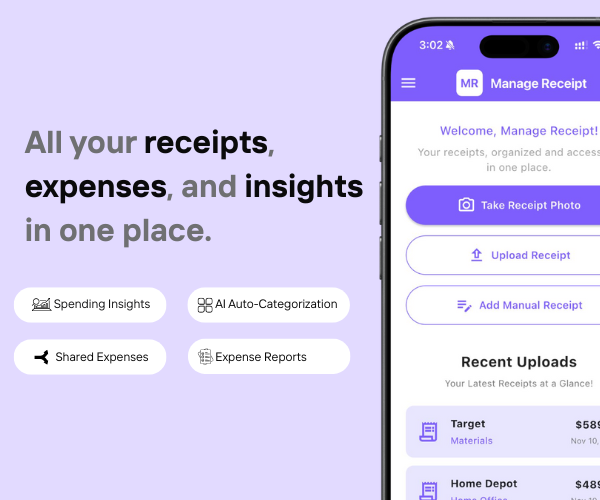
Manage Receipt helps bridge that gap by ensuring every transaction has proper documentation.
With Manage Receipt, you can:
Capture receipts instantly to prevent loss
Store all receipts in one centralized system
Access proof quickly for approvals and audits
Improve visibility into spending
Reduce manual work and admin overhead
The biggest benefit of using ManageReceipt isn’t just the time you save. It’s the money you keep — because every receipt you capture is a deduction you can actually claim.
Try ManageReceipt free today — available on iOS and Android. No credit card required.
Click Here to know more about how Manage Receipt helps small businesses.

Raising prices is one of the most valuable and most avoided levers in small business. The fear of losing clients is real — but in most cases, it’s significantly larger than the actual risk.
Clients who value your work will stay. Clients who leave over a reasonable increase were likely not your best clients to begin with. And the clients you attract at a higher price point tend to be easier to work with, more respectful of your time, and more committed to the outcomes you’re delivering.
The business that raises prices confidently and regularly is not the business that loses clients — it’s the business that grows, breathes easier financially, and has the margin to invest in doing **better work**.
The best time to raise your prices was last year. The second best time is now. Start with a clear number, communicate it professionally, and trust that you’ve built something worth paying for — because you have.

Every tool on this list helps you run your business better. But none of them matter if your financial records are a mess.
Before you invest in project management software, marketing tools, or e-commerce platforms — make sure your expense tracking is airtight. Every purchase you make for your business needs to be documented, categorised, and stored correctly. Not just for tax season, but for understanding whether your business is actually profitable.
That is exactly what ManageReceipt is built for. Scan a receipt in seconds, add the business purpose, and it is stored, backed up, and export-ready. No shoebox of crumpled paper. No scrambling at tax time.
Download ManageReceipt Free — Start Tracking Expenses Today
iOS & Android | managereceipt.com


© 2025 Manage Receipt. All Rights Reserved.
