In this article
- Free donation receipt templates
- What is a donation receipt?
- What is a 501(c)(3) donation receipt?
- What a donation receipt should include
- Donation receipt example
- How to create a donation receipt
- Receipt vs. acknowledgment letter
- When a donor needs a receipt
- Organizing donation receipts
- Managing digital donation receipts
- How ManageReceipt helps
- Mistakes to avoid
- FAQs
- Make every donation receipt count
Every gift deserves a proper thank-you, and for many donors, that thank-you needs to double as tax paperwork.
If your nonprofit is still typing up receipts one by one, or you're not sure your current donation receipt format covers everything the IRS asks for, this guide is for you. You'll get free donation receipt templates in Word and PDF, a plain-English checklist of what a 501(c)(3) receipt must include, sample wording you can copy, and simple ways to keep your donation records organized all year.
Key takeaways- Donors need a written acknowledgment for any single gift of $250 or more to claim a tax deduction.
- The IRS requires your organization's name, the cash amount or item description, and a goods or services statement. Add the donor's name, the date and your EIN so the receipt is complete.
- Never put a dollar value on donated items. Describe them and let the donor value them.
- Starting with the 2026 tax year, donors who don't itemize can deduct up to $1,000 in cash gifts ($2,000 for joint filers), so even smaller donors will want receipts.
Free Donation Receipt Templates
Pick the donation receipt template that matches how your nonprofit receives gifts. Each one is available in Word and PDF, ready for your logo and details.
Printable Donation Receipt Template
Best for: events, walk-in donations, church services and in-person fundraisers
Two receipts fit on a single sheet of letter paper, so you can print a stack for the donation table and let volunteers fill them in on the spot. It works like a donation slip or a page from a receipt book, without the cost of pre-printed forms.
What's inside: organization details, donor name, date, amount or item description and a pre-printed goods or services line.
Download: Word PDF
Donation Receipt Template for Nonprofits
Best for: small nonprofits, community groups and volunteer-run charities
A clean, everyday nonprofit receipt template (or charity receipt template) for cash, check, card and online gifts. It has room for your logo, a short mission line and a personal thank-you, so it works as a receipt and a note of thanks in one.
What's inside: logo, mission line, donor details, gift details, payment method and a thank-you message.
Download: Word PDF
501(c)(3) Donation Receipt Template
Best for: registered 501(c)(3) organizations handling gifts of $250 or more
Built to cover every item the IRS expects in a written acknowledgment. It includes your EIN, the full goods or services statement, and a separate section for in-kind (non-cash) gifts such as food, clothing, furniture or equipment, where you describe items without valuing them.
What's inside: EIN, donor and gift details, goods or services statement, in-kind gift description and a signature line.
Download: Word PDF
What Is a Donation Receipt?
A donation receipt, sometimes called a charitable contribution receipt or donation tax receipt, is written proof from your nonprofit that a gift was received. It confirms who gave, what they gave, when they gave it and whether they got anything in return.
It does two jobs at once:
- For donors, it's the record they need to claim their charitable contribution at tax time.
- For your nonprofit, it's part of your financial records and a simple way to show appreciation.
The IRS doesn't require a specific design, form or format. Paper, email and PDF all work. What matters is the information on it.
What Is a 501(c)(3) Donation Receipt?
A 501(c)(3) donation receipt is a receipt issued by an organization the IRS recognizes as tax-exempt under section 501(c)(3). Because gifts to these groups are generally tax deductible, this tax deductible donation receipt carries real weight for your donors.
The IRS officially calls it a contemporaneous written acknowledgment. “Contemporaneous” is about timing: the donor must have it in hand before they file. Here's the short version:
- Required for: any single contribution of $250 or more
- Needed by: the date the donor files their return, or the return's due date (including extensions) if that comes first
- Without it: the donor's deduction can be denied, even with a canceled check as proof
Most nonprofits also add their EIN (Employer Identification Number). It isn't strictly required, but it helps donors and their tax preparers confirm your tax-exempt status in seconds using the IRS Tax Exempt Organization Search.
What Should a Charitable Donation Receipt Include?
Run every charitable donation receipt through this checklist before it goes out. The first list is what the IRS requires in a written acknowledgment. The second is what makes the receipt complete and easy to use.
Required by the IRS for gifts of $250 or more- Your organization's name
- Cash amount, for checks, cards and online payments
- Item description for in-kind (non-cash) gifts, such as “three bags of children's clothing” or “40 shares of XYZ common stock,” with no dollar value
- Goods or services statement, either “No goods or services were provided in exchange for this contribution” or a description and good-faith estimate of what the donor received
- For churches and religious groups: if the only thing a donor received was an intangible religious benefit, say so on the receipt
Recommended on every receipt- Donor's name
- Date of the gift. Donors need it for their own records, and a receipt for a smaller cash gift only works as proof if it shows the date.
- Your address and EIN
- Name or signature of the person issuing the receipt
Leave these off: the donor's Social Security number (it isn't needed), any value for donated items (that's the donor's job) and any value for volunteer time, which isn't tax deductible.
Sample wording you can copy
The goods or services statement is the line nonprofits get wrong most often. These three versions cover almost every gift, whether you send a receipt, an in-kind donation letter or a receipt by email.
- Cash gift, nothing given in return: “Thank you for your contribution of $300, received on September 14, 2026. No goods or services were provided in exchange for this contribution.”
- In-kind gift: “Thank you for your donation of 12 cases of canned vegetables, received on September 14, 2026. No goods or services were provided in exchange for this contribution.”
- Gift with a benefit, such as a gala ticket, auction item or sponsorship package: “Thank you for your payment of $200 for our annual dinner. The estimated fair market value of the dinner is $60, so the tax-deductible portion of your payment is $140.”
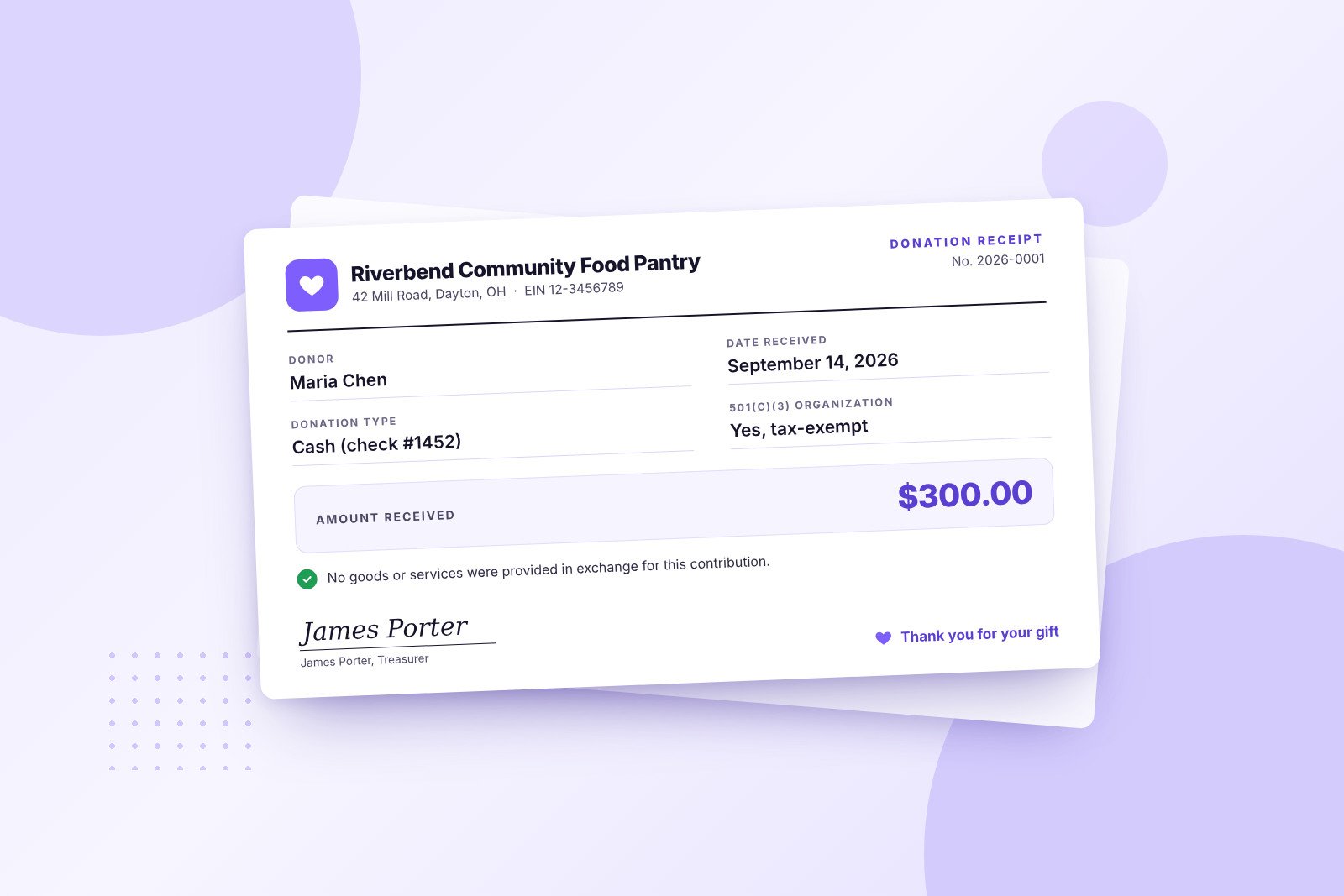
Donation Receipt Example
Here's a sample donation receipt for a cash gift.
Riverbend Community Food Pantry42 Mill Road, Dayton, OHEIN 12-3456789
DonorMaria Chen
Date receivedSeptember 14, 2026
Donation typeCash (check #1452)
Amount$300.00
Goods or services providedNone. No goods or services were provided in exchange for this contribution.
Issued byJames Porter, Treasurer
Sample receipt (sample organization)
Every required detail is covered, so Maria can pass this straight to her tax preparer.
How to Create a Donation Receipt for a Donor
Once your template is ready, each receipt takes just a few minutes.
- Set up your master copy. Add your nonprofit's name, address, EIN and logo once and save it.
- Add the donor and date. Use the date the gift was received.
- Record the gift. Enter the dollar amount for cash gifts, or a clear description for items.
- Add the goods or services statement. If the donor got something back, like a gala dinner, describe it and estimate its value.
- Say thank you. One sentence about the gift's impact makes the receipt feel personal.
- Send it and save a copy. Email or mail it, then file your copy with your donation records.
Year-end donation receipts
For recurring donors, one year-end statement can replace a stack of single receipts. Some nonprofits call it a giving statement, and churches often call it a contribution statement. The IRS accepts an annual summary as long as it lists each gift's date and amount and carries the same goods or services statement.
Donation Receipt vs. Donation Acknowledgment Letter
Both can meet IRS rules. The difference is format and tone.
| Donation receipt | Donation acknowledgment letter |
|---|
| Format | Short form or slip | Full letter |
| Tone | Factual | Warm and personal |
| Best for | Small or in-person gifts | Major gifts, annual summaries, loyal donors |
| Meets IRS rules? | Yes, with the required details | Yes, with the required details |
A nonprofit donation acknowledgment letter gives you space to share the impact of a gift. Just make sure the IRS details are still in there.
When Does a Donor Need a Donation Receipt?
The answer depends on the size and type of the gift.
IRS donation rules at a glance- Cash gifts under $250: your receipt isn't required, but donors still need a bank record or a written record from your nonprofit showing its name, the date and the amount. A receipt keeps things simple.
- $250 or more in a single gift: a written acknowledgment is required for the donor's deduction.
- Over $75 and partly a purchase: you must give a written disclosure showing the deductible amount, which is the payment minus the fair market value of what the donor received. Nonprofits that skip it can face a penalty of $10 per contribution, up to $5,000 per event or mailing.
- Non-cash gifts over $500: the donor files Form 8283. Your receipt describes the items.
- Non-cash gifts over $5,000: the donor generally needs a qualified appraisal, and your nonprofit signs the donee acknowledgment on Form 8283. Publicly traded stock is the main exception.
- Vehicles worth more than $500: special rules apply, including Form 1098-C.
Timing matters. Send receipts promptly, or at least by the end of January, so donors have them before they file.
New for the 2026 tax year: donors who don't itemize can deduct up to $1,000 in cash gifts to qualifying charities ($2,000 for married couples filing jointly) on the returns they file in 2027. Gifts to donor-advised funds and supporting organizations don't count, and neither do in-kind gifts. The IRS tips for non-itemizers tell donors to keep receipts or bank records, so expect more requests from smaller donors this year.
How much can donors claim without a donation receipt?
Nothing, if they have no record at all. There's no dollar amount a donor can deduct on trust. What changes with the size of the gift is the kind of proof they need, as IRS Publication 526 explains.
For a cash gift under $250, a bank record such as a canceled check or card statement is enough, and so is a written record from your nonprofit. For $250 or more, a bank record alone won't do. The donor needs your written acknowledgment. That's why it's worth giving a receipt for every gift, including cash dropped in a collection box.
How Nonprofits Can Organize Donation Receipts
Good records make audits, grant reports and year-end summaries far less painful. Here's a routine that works for most small teams.
Five habits for organized donation records- Number every receipt and add it to a donation log. A sequence like 2026-0001 makes gaps easy to spot.
- Store copies in one shared place, not on personal laptops.
- Match receipts to deposits at the end of every month.
- Tag recurring donors so year-end summaries take minutes, not days.
- Back up everything in at least two locations.
Don't forget your nonprofit's own expense receipts. Board members, auditors and grant funders will want to see where the money went, not just where it came from.
How to Manage Digital Donation Receipts
Digital donation receipts are faster to send, easier to find and harder to lose. An emailed receipt is fine for the IRS as long as it carries the same details as a paper one. Most online giving platforms send them automatically, but double-check that the default version includes a goods or services statement. Many don't.
Quick wins for digital receipts:
- Name files consistently, using the receipt number, donor name and amount.
- Send PDFs so formatting holds up on any device.
- Save the sent copy next to the donation record.
- Keep records at least three years, or longer if your state or auditor asks.
One thing to check: when a gift reaches you through a social media fundraiser, a crowdfunding page or a donor-advised fund, the organization that collected the money is usually the one that issues the donor's tax receipt. Confirm how each platform handles it before you send a second receipt for the same gift.
How ManageReceipt Can Help Organize Nonprofit Receipts
Donation receipts record money coming in. Grant funders and boards will also ask about money going out, and for many small nonprofits that's where records fall apart. Volunteers buy supplies with their own cards, receipts end up in coat pockets, and reimbursements wait weeks.
ManageReceipt gives your team one place to send those receipts. Volunteers photograph a receipt with the receipt scanner, and you can bundle them into an expense report when it's time to pay people back. Your IRS determination letter and copies of issued donation receipts can live in the doc wallet, so they're easy to find when a donor or auditor asks.
For more on this, read our guide to expense management for nonprofits.
Common Donation Receipt Mistakes to Avoid
A small slip on a receipt can cost your donor their deduction. Watch for these:
- Missing goods or services statement. The most common gap on nonprofit receipts.
- Valuing donated items. Describe them. Don't price them.
- No date. Donors need it for their records, and a small cash gift isn't backed up without it.
- Late receipts. Donors need them before they file.
- No quid pro quo disclosure. Gala tickets, auctions and dinners need the deductible amount spelled out.
- Including Social Security numbers. Not needed, and a privacy risk.
Frequently Asked Questions
What is a 501(c)(3) donation receipt?
It's a written record from a tax-exempt 501(c)(3) organization confirming a donor's gift. Donors need one for any single contribution of $250 or more to claim a deduction.
What should a donation receipt include?
The IRS requires your organization's name, the cash amount or a description of donated items, and a statement about whether the donor received goods or services in return. Add the donor's name, the date and your EIN so the receipt is complete. A signature is a nice addition.
Is a donation receipt tax deductible?
The receipt itself isn't deductible. It's the proof donors use to deduct their gift. Without it, a deduction can be denied.
Does a nonprofit need to provide a donation receipt?
For single gifts of $250 or more, donors need one to take a deduction, so it's best practice to always send one. For payments over $75 that are partly for goods or services, a written disclosure is required.
Can a donation receipt be sent by email?
Yes. The IRS accepts electronic acknowledgments, so an email or an attached PDF works as long as it includes the required details.
What is an in-kind donation receipt?
It's a receipt or letter for a gift of goods instead of money, such as food, clothing, furniture, equipment or stock. Describe what was given and when, add the goods or services statement, and leave the dollar value to the donor.
Is a donation receipt the same as a donation form or invoice?
No. A donation form collects a donor's details and gift, a receipt confirms the gift after it arrives, and an invoice bills for something owed. A donation is voluntary, so nonprofits send a pledge reminder before a gift and a receipt after it.
What is the difference between a donation receipt and acknowledgment letter?
A receipt is short and factual. An acknowledgment letter is fuller and more personal. Both meet IRS requirements when they include the required details.
Make Every Donation Receipt Count
The right donation receipt template protects your donors' deductions and shows every supporter their gift was received and appreciated. Pick a template, check it against the IRS checklist and send receipts on time.
Then give your nonprofit's own spending records the same care, so every dollar in and every dollar out has a paper trail.
Templates for the receipts you give. Manage Receipt for the ones you get.Scan, store and report on every expense receipt.
This guide gives general information about US donation receipt rules. It isn't tax or legal advice, so check IRS Publication 1771 or a tax professional for your organization's situation.